

Chalet Market Report

Advance booking trends in ski holidays 2012/13 to 2026/27
Each Autumn we take a snap shot of the upcoming winter season's ski holiday bookings within the chalet and chalet apartment marketplace. We sell accommodation from over 170 different suppliers across all the main alpine resorts. Our total chalet inventory is usually around 1,250 individual properties which accounts for 15,000 beds each week. Over the course of the whole season the chalets we represent account for approximately 250,000 chalet bed weeks making up maybe 15%-20% of the total UK skier market going to the Alps.
The analysis we conduct therefore is a pretty accurate snapshot of the British ski holiday marketplace as a whole, and by comparing one year vs another trends in the buying habits of British skiers can be observed. Some years sales are bouyant and in other years they are less so. Each Autumn we can identify the weeks that are selling the most (nearly always Christmas, New Year and February Half Term) and those that are lagging behind (usually Easter). Given that Christmas and new year weeks occur at the start of the winter season and the Easter April sales are a long time ahead this is perhaps not surprising when we are looking at the volume of sales for each departure week in October. However, it is still interesting (at least for us) to view how sales are going across the market.
Author details:
All data, stats and comments on this web page are made by Simon Hoskyns (Partner at Alpine Answers). Almost 40 years experience gained within the ski holiday marketplace having spent time with Ski Solutions, The Ski Club of Great Britain and Powder Byrne before becoming Partner at Alpine Answers in 1997.
The Pandemic affected winter ski seasons
The Covid Pandemic really started to take hold at the beginning of March 2020 (towards the end of the 2019-20 winter) and the last travel ban, which had been instigated by the French authorities, was not lifted until mid-January 2022. Although virtually no skiers made it to the Alps for the season 2020-21 it is interesting to note that we had quite a few optimistic clients who had booked during the summer of 2020 to ski that winter. What fun we all had when those holidays were all cancelled by the winter travel bans which necessitated full refunds or deferrals to the following winter (2021-22). That winter was a particular low point for all ski holiday companies. Barely had they recovered from the travel bans imposed in March and April 2020 (the end of the previous winter) when they were plunged yet again into the maelstrom of cancellations, refunds and deferrals for the entire winter of 2020-21. Most ski companies went down to the absolute bare minimum of working staff, us included, others folded under the financial pressure and a few just gave up as business became simply unviable.
Fast forward to October 2021 and it's easy to see the 'post Covid money spending bounceback' taking hold. The summer of 2021 was particularly hectic with advance holiday booking sales. By October the New Year week was all but sold out, Christmas and early January were also heavily booked up. In fact the whole winter season was heavily sold months and months in advance. All was looking good for the ski holiday industry at this point in time. That is until Omicron reared its ugly head at the end of November 2021. The French then took their gleeful opportunity to prevent British travellers from entering France, a decision they took with immediate effect on Friday 17th December. At a stroke all our Christmas, New Year and early January holidays to France were cancelled and once again we were thrown into the chaos and money losing drama of refunds and defferals. Millions of pounds worth of holidays that we had worked hard to make during the summer of 2021 were effectively wiped out by Macron and his chronies. Those were dark days indeed.
Winter 2026-27: Stats to be released in October
Winter 2024-25: October 01st 2024
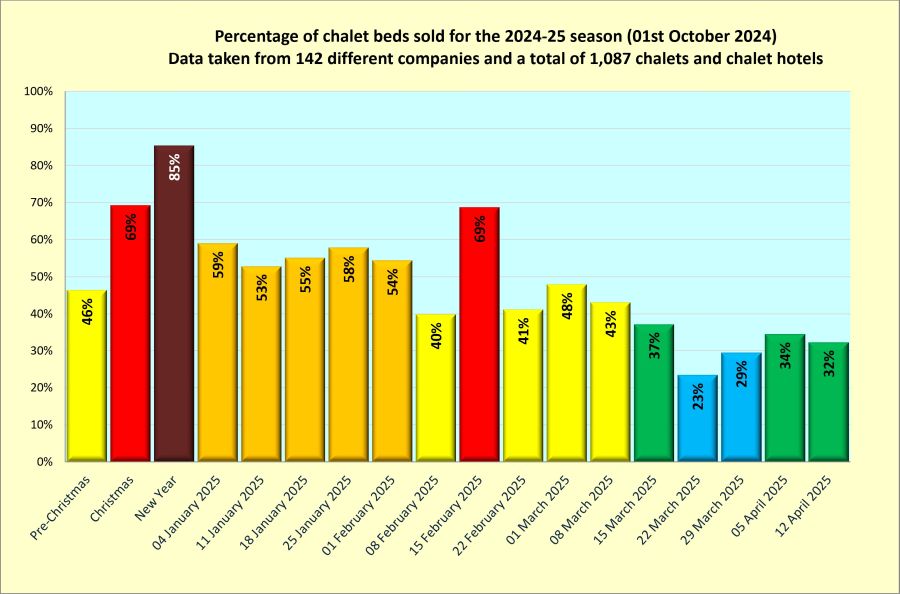
Looking at the volume of sales for each winter season departure week of the season at the end of Sept/beginning of October we can see how well the front half of the ski season is sold compared to the back half. This illustrates the trend we are seeing over recent years for skiers to shy away from booking holidays in March and April in favour of going in December and January. 10 years ago January was considered very low season and bargain hunters could choose from a wide selection of last minute bookings at heavily discounted prices. Fast forward to the 2024-25 season and already by the end of summer 2024 the January weeks were well sold. In contrast late March and early April were very undersold.
We can only assume that this shift in early bookings for January ski holidays is a result of skiers fearing poorer snow conditions in March and April. How ironic then that the second half of the winter season in recent years has seen huge snowfalls and fabulous skiing conditions (far better in fact than the colder months of December and January). And those fortunate enough to ski in March and April over the last couple of seasons have enjoyed these great conditions as well as benefitting from quiet slopes!
Winter 2023-24: October 03rd 2023
This time last year we were talking about the bounce-back in holiday bookings following the 'all clear' on international travel. Certainly, last winter ski season 2022-23 was a bumper one in terms of bookings, number of clients and value of bookings. In fact, the UK holiday industry (excluding staycations) experienced a great year of trading - and this was just as well given that the preceding 18 months had seen no client bookings at all (for the ski holiday industry).
It was a shame that the British press made such a meal about the poor snow conditions experienced over the new year and beginning of January 2023. Their doom and gloom articles destroyed the end of season March/April holiday sales, which for the large part are made in the new year just as the 'poor snow in the Alps' stories were hitting the front pages. Ironically the ski conditions at the end of the season in April 2023 turned out to be truly fantastic and the best they had been for years. Regular large snowfalls interspersed with beautiful sunny weather made for perfect ski conditions both on and off-piste.
Much has happened in the last 12 months since our last blog on the state of the ski chalet holiday marketplace. Disturbing wars, high inflation, higher interest rates, talk of a recession in the UK and a downturn in global productivity. Boy....is there any good news out there?
Good news from the ski holiday industry...
1) There have been huge snowfalls across the Alps over the last week and further large snowfalls expected soon. The snow has reached all the way to the valley floors and on the upper slopes well over 60cm has fallen. Temperatures are cold (and getting colder) so this is boding very well for a great start to the winter skiing.
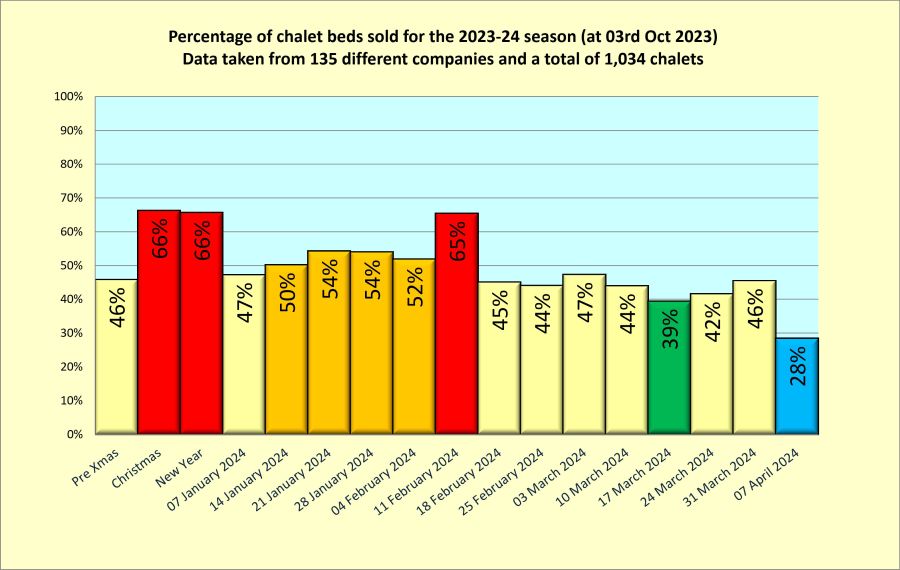
2) Bookings for the ski chalet market remain very buoyant, despite the effects of inflation. The graph below shows the percentage of beds sold for each week of the season. Christmas and New Year week are already heavily sold, and sales for the half term week (starting 10th/11th February 2024) are not far behind. Even the low season weeks of January and March are getting very busy with only the week starting 06th/07th April 2024 relatively undersold (although given that April is almost 6 months away this is not a surprise).
Winter 2022-23: October 25th 2022
The bounce back in holiday sales immediately post-Covid was inevitable. After being restricted (by and large) from international travel for the best part of 18 months the World wanted to make up for lost time and book as many holidays as their finances would allow.
Summer of 2021 was a busy time for us as we took hundreds of bookings for the 2021-22 winter from clients desperate to get away to the slopes. All looked set fair for a great winter until we hit a rather large 'bump' in the road to recovery in December 2021 and early January 2022. European governments took the opportunity to seemingly punish British holiday makers with travel bans that sprang up with little or no warning. We lost approximately 25% of our annual business last winter when first the Swiss, and then more seriously the French, said a firm "non" to Brits coming to the Alps. Their knee-jerk reaction wiped out our Christmas, new year and beginning of January sales which plunged us into the chaos of dealing with all the refunds and re-bookings, amid the clamour from other clients wanting to book for later in the same season. No one in the ski holiday industry wants a repeat of the nightmare of Winter 2021-22. RIP is all I want to say.
The airlines also had their own issues this Spring and Summer. Short staffed and therefore ill-prepared for the booking rush they struggled with baggage handling in particular, with double the normal number of flights being cancelled and many more suffering severe delays. It probably felt worse than it actually was (only 4% of flights were cancelled during that time compared to a normal figure of 2%) and most of the ill-feeling towards the airlines was whipped up by the press, who did what they do best.
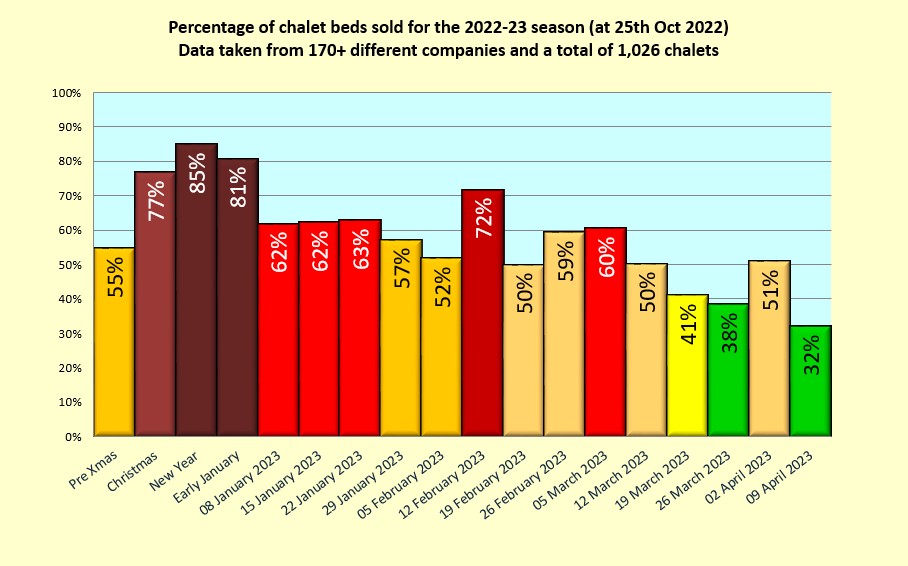
But enough of dwelling on the past, and the woes of the travel industry in general. We need to look forward and hope for a better run on things for winter 2022-2023. One thing we do here at Alpine Answers is take a look at the ski chalet market place in mid-October - looking at the state of play for the whole of the approaching winter's sales. We work with over 170 different ski chalet companies and have bed bank data encompassing over 1,000 chalet and chalet hotel properties in the Alps. Our portfolio of ski companies and properties is not necessarily representative of the whole of the ski holiday industry but it certainly can be used as a barometer reflecting the state of the entire ski holiday market.
The size of our ski chalet portfolio hasn't changed much since 2015 but its composition certainly has. The number of chalet companies offering package holidays with flights and transfers has needless to say fallen sharply. However, that has in fact matched the preference for clients wanting to drive to resort rather than fly (high prices from airlines and the hangover from the summer of delay and cancellation worries putting them off). We have also seen the rise of the self-catered chalet market which now accounts for 30% of our chalet stock, and even the increasing number of chalets that come with pre-cooked meal delivery (contactless catering) - a useful hybrid holiday product offering a halfway house between traditional catered and self-catered ski holidays.
Looking at the sales made to date across the market for ski chalets of all types (catered, self-catered and contactless) the bounce back in bookings is clear to see.
Winter 2021-22: October 22nd 2021
What a strange and unpleasant last 17 months the UK travel industry has endured! With hardly any UK skiers making it to the Alps since 07th March 2020, and a completely null season last winter with no one able to travel, we badly need this winter season to go ahead. And, so it would seem, our clients are feeling exactly the same way. Normally at this time of year we enjoy a rest period before the peak selling months of September, October and November come around. Apart from taking bookings from clients eager to secure favourite chalets and hotels for the peak weeks of the winter season the general level of sales would be low, with plenty of availability still showing. However, this year has been like no other and has exhibited unusual sales patterns. There are two principal factors that have changed the landscape of the ski holiday market place for winter 2021-2022...
Deferred Holidays
Many of the bookings for last winter ski season (2020-21) which we took during the preceding summer could not go ahead as planned. Nearly all of the package holidays sold were cancelled and refunded in full to clients (under the terms of the Package Travel Regulations). However, the bookings that did not constitute a package (accommodation booked without travel arrangements) were simply deferred to this coming winter season 2021-22. These clients were not refunded by the accommodation provider and instead had their bookings moved a whole 12 months later.
Surge in Demand
The period between January 01st and mid-April 2021 was a crazy busy time for us at Alpine Answers. OK - we did have a smaller team than usual with most of our sales staff furloughed but even taking this into consideration we were extremely busy taking bookings for the winter 2021-22 season. Our sales figures at the start of this year were not far off what a full sales team would have achieved in a normal October or November (traditionally our two biggest months for sales). This early peak in sales has subsequently tailed off but we are still selling ski holidays for next winter at a steady rate.
These two factors have led to a situation whereby the coming winter season is beginning to look quite full. We are currently in a situation whereby almost 50% of winter accommodation is already booked. In a normal year we do not pass this mark until mid-October. So, in effect, we are three months ahead of where we would normally expect the ski holiday market to be for the coming winter season.
How will holiday sales continue to pan out?
It remains to be seen if we will experience the normal peak selling months of September, October and November. These three months, after the summer holidays, are when clients look ahead to the winter and skiing. It's our guess (providing international travel is back on everyone's agenda) that we will see this normal peak booking period. And if that is the case we will start to run out of accommodation options for our clients, especially if they are looking to book one of the peak weeks (Christmas, New Year, February Half Term or Easter).
The Chalet Holiday Market
We collate price and availability data from over 170 different chalet companies offering almost 1,000 chalets between them. Our portfolio of properties spans the entire ski chalet marketplace for the Alps. From out and out luxury to simple good value; from 5 star fine-dining to do-it-yourself self-catering; from cheap French purpose built resorts to the smartest and most desirable locations in the Alps - we cover it all. With a fair degree of certainty we can examine this data and draw conclusions that will reflect the state of the ski holiday market as a whole.
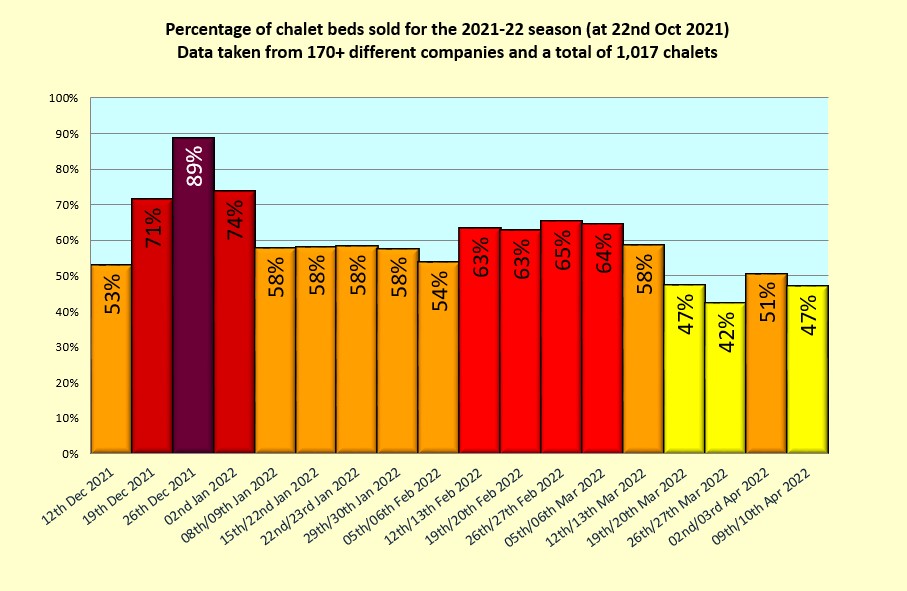
The Peak Weeks
Already the festive season is looking highly popular. Christmas week is 53% sold and New Year 67% sold out. The beginning of January is normally undersold but for 2022 is for many still in the school holidays and popular as a result. Furthermore there are plenty of short break ski holidays from 03rd, 04th and 05th January through to the 08th/09th January for a stay of 4 - 5 nights. These have proved popular on account of their good value. Unusually for 2022 there are two weeks for the UK school half term in February. The main half term week starting 12th/13th February 2022 is already 51% sold but the 2nd week (starting 19th/20th February) is not far behind at 47% sold. The main Easter school holiday week starting 02nd/03rd April 2022 is already approaching being half full (42% full) which given that it is a full 9 months away is remarkable.
Who has sold the most?
Of course some chalet companies are hugely popular with armies of returning clients, whilst other companies are less popular. This is normal although it is hard to fully justify why some companies do so well whilst others are left scratching their heads thinking 'what's going wrong'. Perceived value and quality of product comes into play, successful marketing and PR will also make a difference. Website design and user experience combined with how easy the booking process is (either on-line or with a sales team) also has a bearing. However, sometimes it's the intangible nuances that can make the difference. It can simply be fashionable to book with one chalet company over an other - in certain socio-economic groups this is an important factor. Or maybe a chalet company simply nails it (the right properties, the right resorts, the right price points and the right staff) and is hugely popular as a result.
Alpine Escape with chalets in the Three Valley resorts of Courchevel Le Praz, Meribel and La Tania lead the field and despite having a portfolio of nearly 20 chalets have only a few weeks left to sell for winter 2021-22. By our reckoning they are currently 86% full and surely will completely sell out before the summer is over. Ski Cuisine, always popular, are 79% full, and Fish and Pips are not far behind being 65% full. Le Ski who are one of the larger chalet companies (and one of only a handful still offering ATOL protected package holidays with flights included) are over 70% full for the winter. Impressive given that they have well over 300 chalet beds each week to sell.
If there are winners then there must also be losers. Indeed there are some chalet companies that have hardly got off the ground regards their sales for next winter. Perhaps they are laying low and seeing how the season looks set to pan out. There are after all still big uncertainties surrounding international travel. Furthermore there are uncertainties surrounding Brexit and what this means regards finding seasonal staff for resorts (it's certainly not as easy as it used to be for UK staff to work in the Alps). It would be kind to consider these companies who are lagging behind as 'keeping their powder dry' (no pun intended). Whatever the reason behind current poor performance it's entirely possible, as other chalet companies run out of available holidays to sell, that these companies will see a surge in sales later this year.
Conclusions
We have given up polishing our crystal ball. We certainly wouldn't like to 'hazard a guess' as to what the next winter season holds for the ski holiday industry. If international travel comes back in time (and stays) then we will all have a bumper winter (and god knows we need it). If it doesn't then we will have to endure another 12 months of working without pay. Boom or bust is exactly what the ski travel industry is facing right now.
Winter 2020-21: October 16th 2020
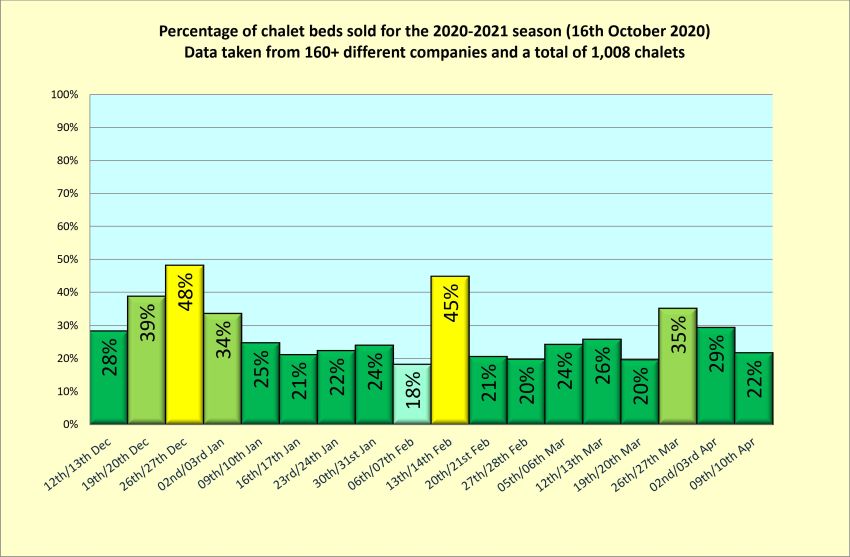
We are writing this in September 2026 looking back to mid-October 2020 and the picture of advance holiday bookings for the winter 2020-21. The initial travel bans of March and April 2020 (when the Covid Pandemic first hit) did not dampen the enthusiasm for UK based skiers to book their annual ski holiday. During the summer of 2020 we still took £millions of pounds worth of bookings for the winter ahead, even though nearly all of our staff were furloughed. Although we did take lots of bookings during that summer it is clear to see that the amount of forward bookings for the winter was down by approximately 50% compared to what we might have ordinarily expected.
As it turned out the 2nd UK Lockdown of November 2020, the 3rd Lockdown of January 2021 and the associated international travel bans/restrictions wiped out all of the ski holiday bookings for the winter ski season 2020-2021. Those clients who had booked package holidays (flights and accommodation booked together) were able to get full refunds and those who had not were mostly offered the option from their accommodation provider to defer their booking until the following winter 2021-2022.
Winter 2019-20: November 14th 2019
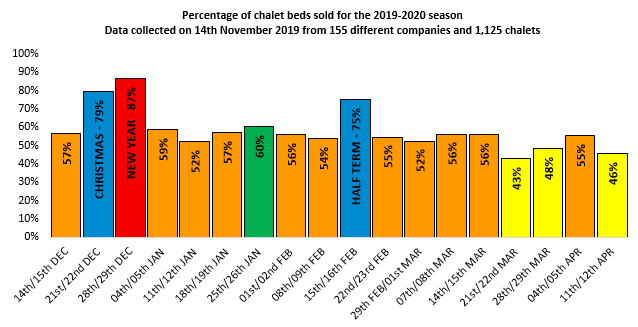
We are writing this in September 2026 looking back to mid-November 2019 and it's fair to say that hindsight is an interesting thing. Remembering back to November 14th 2019 now it seemed that the world of travel and ski holiday bookings was in a predictable place. Christmas and New Year weeks were well sold, as were the weeks of January and February. No one had heard of Wuhan, or Covid, or Chris Whitty, and who knew where the town of Barnard Castle was located?
Pre-Covid pandemic it's interesting to note that the advance holiday sales for the months of February and January were equally bouyant, and even the 1st week in the April school holidays was heavily sold (a full 5 months ahead of time). The trend that exists now (Sept 2026) for clients to favour the 1st half of the season over the 2nd half had not taken hold at all.
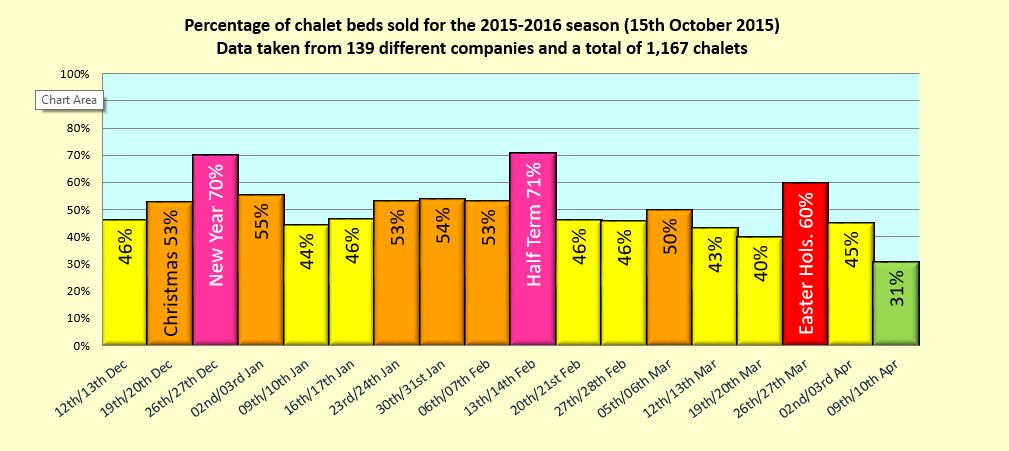
Winter 2015-16: October 15th 2015
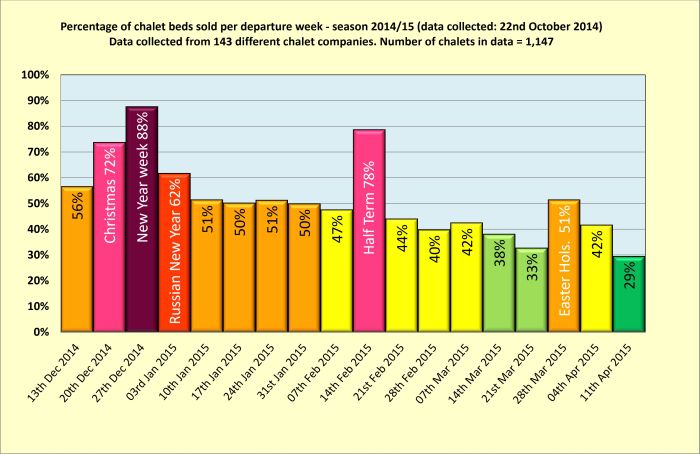
Winter 2014-15: October 22nd 2014
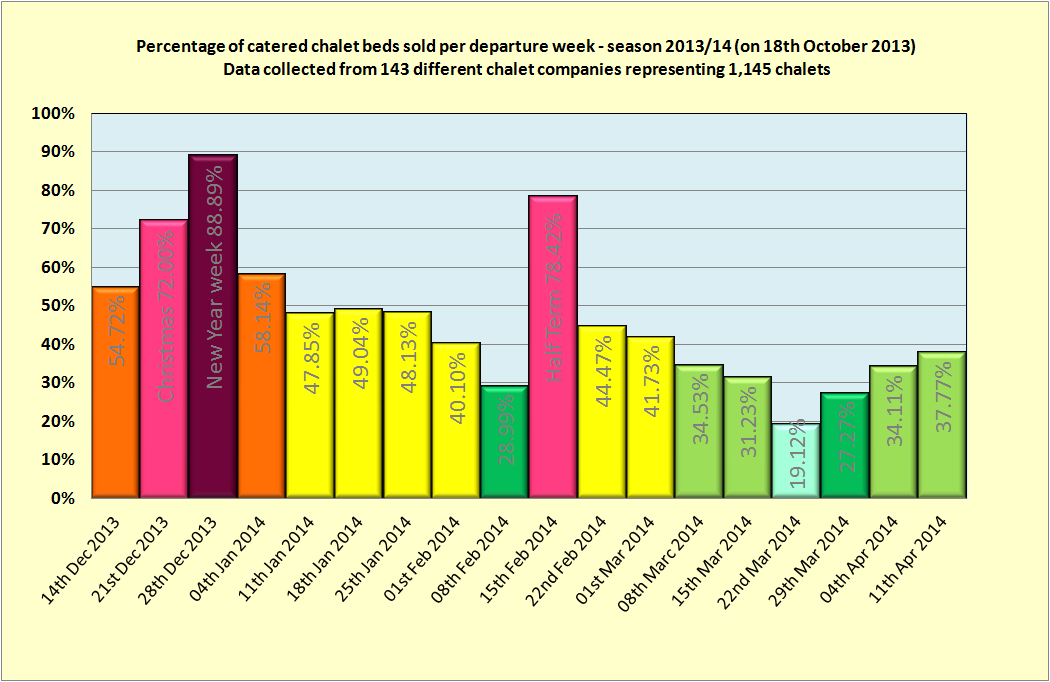
Winter 2013-14: October 18th 2013
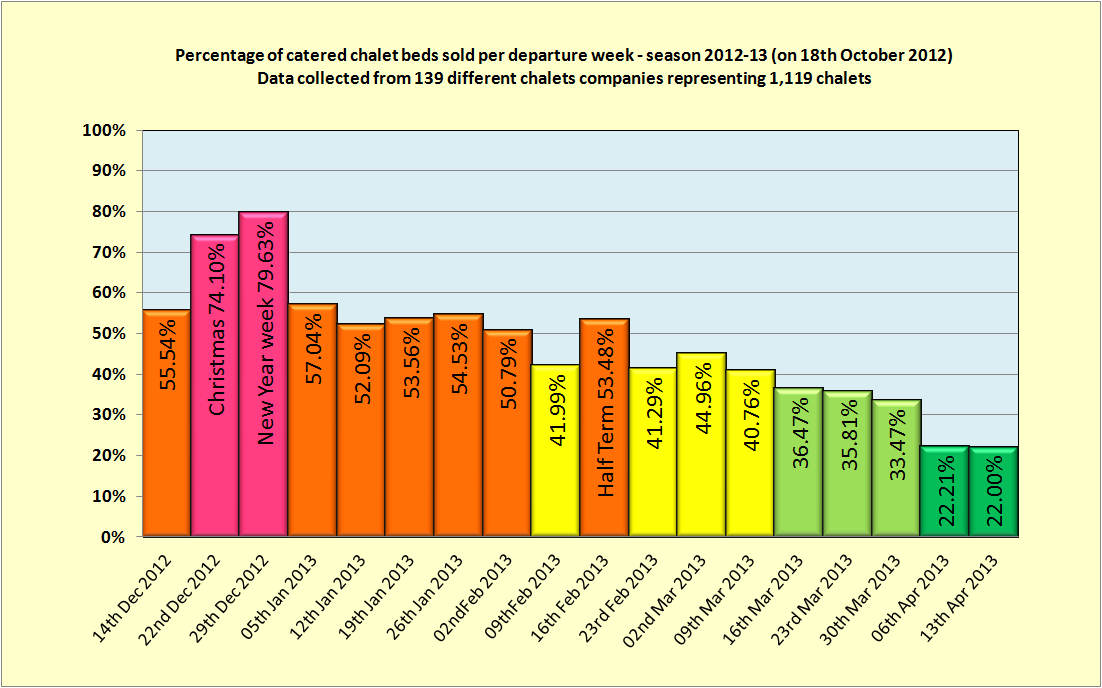
Winter 2012-13: October 18th 2012